Book
Hydraulic calculations and evaluation of efficiency
M. Jovanović
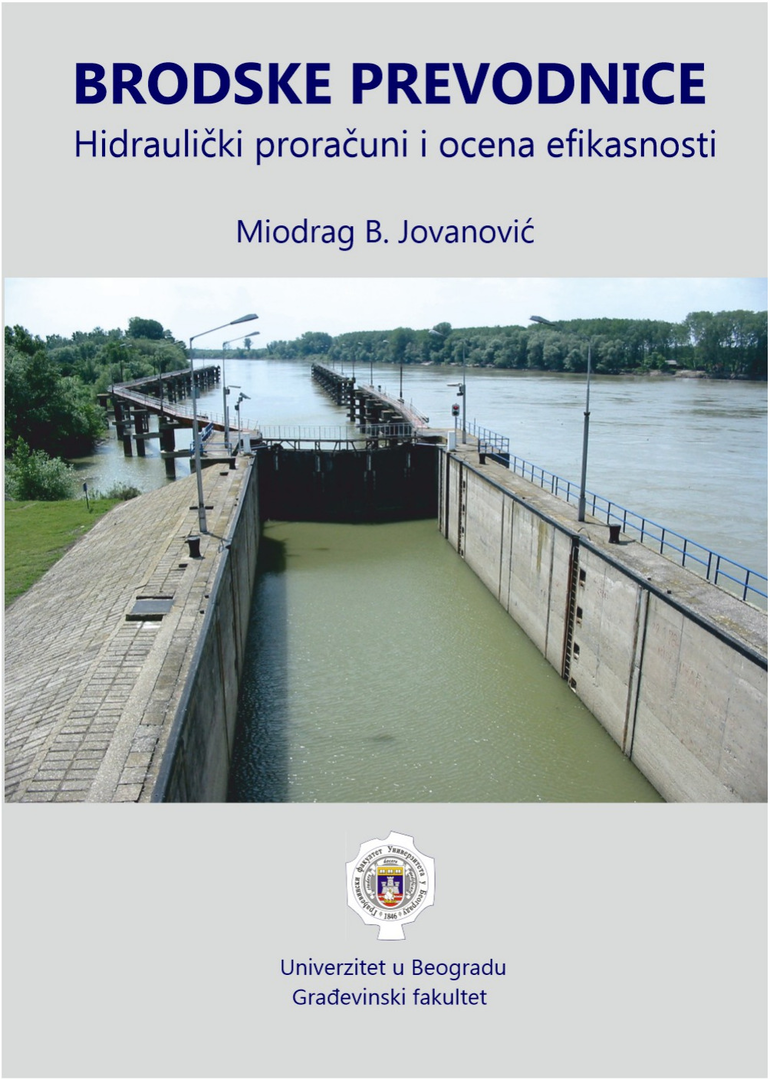
M. Jovanović
Ship Locks
Hydraulic calculations and evaluation of efficiency
Faculty of Civil Engineering
Belgrade, 2025.
ISBN 978-86-7518-251-1
Pages: 302
About the book:
"Through the chapters of this book, readers are gradually introduced to the development and use of numerical models of different levels of complexity (1D, 2D, 3D). The special value of the book is given by numerous solved examples that accompany the presentation and complete it in terms of better understanding and easier applicability. In each of the accompanying examples, the necessary input data and the results (obtained by original computer codes) are presented in graphical form. Thus, the conditions were created for the conscientious reader to overcome the problem that interests him, at the chosen level. The explanations, which are given by the author with examples, contain a theoretical part and practical recommendations on how to perform the calculation. It is as if the author was guided by the principle "that the hungry should not be given fish, but taught to fish", so he offered explanations that are much broader than those that can usually be found in user manuals of commercial software. At the same time, the complementarity of numerical and physical models in this area was pointed out in a comprehensive way. Considering the content of this book, with its many diagrams, drawings and excellent photographs, it could be said to be a small encyclopedia on ship locks."
Prof. Radomir Kapor
Prof. Ljubodrag Savić
Prof. Slobodan Đorđević
Contents:
1. GENERAL ABOUT SHIP LOCKS
1.1 Domain of application
1.2 Basic elements of ship locks
1.3 About the design of ship locks
2. EFFICIENCY OF SHIP LOCKS
2.1 Locking process
2.2 Lock capacity
2.3 Operation expenses
3. SIMPLIFIED MODELS OF HEAD-FILLING SYSTEMS
3.1 Structural characteristics
3.2 Valves
3.3 Simplified numerical model
3.4 Existing Software
3.5 Simplified analytical model
4. COMPLEX MODELS OF HEAD-FILLING SYSTEMS
4.1 Linear (1D) unsteady flow models
4.2 Models of multidimensional unsteady flow
5. MODELS OF HEAD-FILLING SYSTEMS WITH A SHIP IN THE CHAMBER
5.1 The "flexible ship" model
5.2 The "rigid ship" model
5.3 Existing Software
6. SIMPLIFIED MODELS OF LONG CULVERT SYSTEMS
6.1 Structural elements
6.2 Simplified inertial model
7. COMPLEX MODELS OF LONG CULVERT SYSTEMS
7.1 Modeling flow in long culverts
7.2 Existing Software
7.3 Hydrodynamically balanced systems
7.4 Frontal or split system?
8. WATER SAVING BASINS
8.1 Water consumption per one cycle
8.2 Application of water saving basins
9. SPECIAL HYDRAULIC CONSIDERATIONS
9.1 Friction losses in culverts
9.2 Water hammer
9.3 Cavitation
10. PHYSICAL MODELS OF SHIP LOCKS
10.1 Scales and laws of similarity
10.2 Measurements on physical models
10.3 Examples of physical models of ship locks
10.4 Concept of composite modeling
Bibliography
Subject index
 English
